Albuquerque doesn't always make the short list when architecture enthusiasts talk about mid-century modern cities. Palm Springs gets the glossy spreads, and Los Angeles gets the quintessential case studies with glitz and glam. Anyone who has spent real time driving the grid of the Northeast Heights or wandering through Netherwood Park knows the truth: Albuquerque is one of the most authentically preserved mid-century modern cities in the American Southwest.
The reason is demographic and economic. Between 1950 and 1975, Albuquerque's population exploded from roughly 97,000 to nearly 290,000, fueled by Kirtland Air Force Base, Sandia National Laboratories, and an expanding University of New Mexico. The city needed homes desperately. What emerged was a generation of builders and architects who blanketed Eastern Albuquerque with ranch houses, contemporary designs, and International Style gems that largely remain intact today. If you're searching for mid-century modern homes in Albuquerque, here is your neighborhood-by-neighborhood guide.
Neighborhood #1: Vista Larga Historic District
National Register of Historic Places
If you want the single most concentrated and historically documented pocket of mid-century modern homes in Albuquerque, Vista Larga Historic District is it. Bound by Indian School Road, Princeton Avenue, Hannett Avenue, and the UNM North Golf Course, this 112-home district was listed on the National Register of Historic Places precisely because of how intact it remains. The street layout and housing pattern are unchanged from the developer's original 1947 plat, meaning you're essentially walking into a preserved 1950s subdivision.
Vista Larga's homes span the full vocabulary of mid-century residential design, from classic Ranch Houses with low-slung hipped roofs and large picture windows to contemporary designs with cleaner geometry and open floor plans, to finally, occasional nods to the International Style. Critically, many homes have been minimally changed over the decades, retaining original materials, workmanship, and design intent. In a city where many MCM homes have been stuccoed over or had their carports converted, Vista Larga is a genuine time capsule.
Walking these blocks is a lesson in how post-war optimism looked in the desert Southwest, with brick and glass, low profiles, and an honest relationship between the house and the land.
Architecturally, you'll find wrought-iron porch supports, front-facing picture windows, recessed entryways, and integrated planters as textbook MCM detailing with a New Mexico sensibility. Homeowners in the district can even qualify for state historic tax credits when making improvements that preserve architectural integrity, making it an unusually favorable place to own and restore.
Neighborhood #2: Netherwood Park
Architect-Designed Gems
Netherwood Park is where you find the more custom, architect-designed end of Albuquerque's MCM spectrum. Located directly north of UNM, the neighborhood contains homes that were conceived by individual architects rather than production builders. Properties here feature the kind of considered details that separate "mid-century inspired" from the real thing: interior courtyard sunrooms with vertical wood slat screens, open beams, clerestory windows, and a genuine dialogue between interior space and exterior landscape.
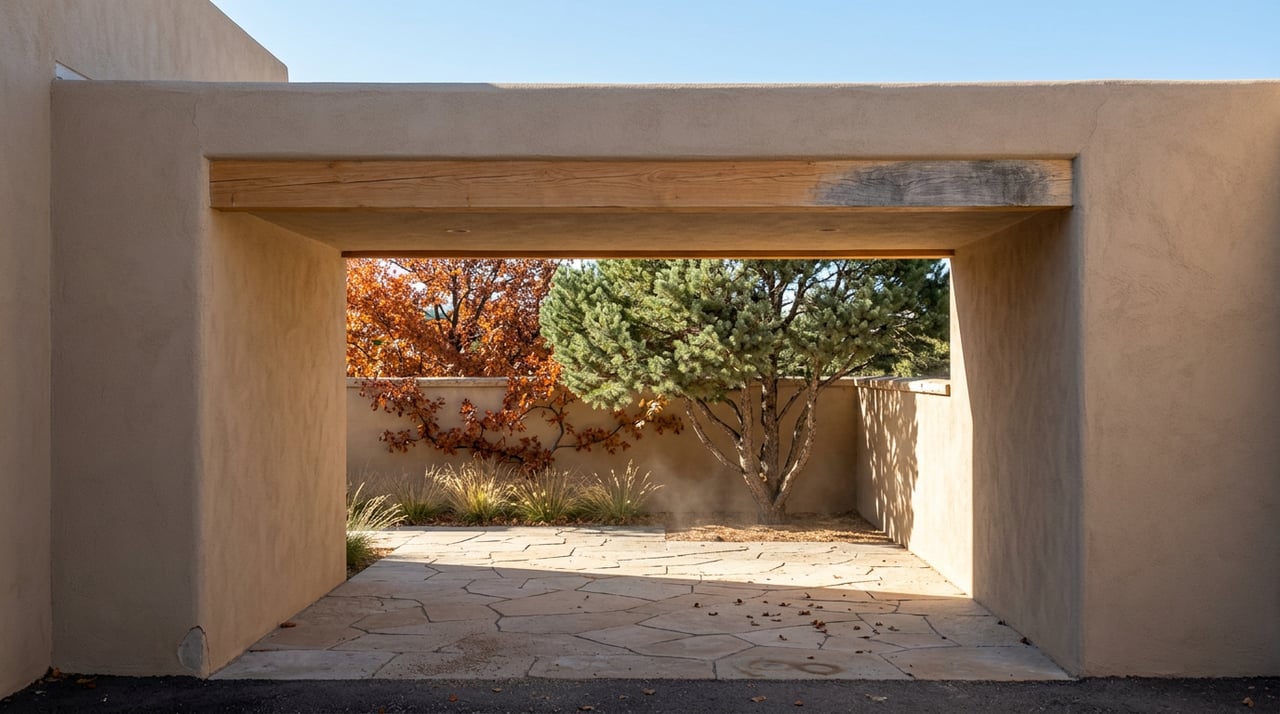
One frequently cited home in the neighborhood was designed by architect Art Dekker and exemplifies the Netherwood character: a sleek open roofline with a single defining beam framing a courtyard, exterior masonry with creative brickwork detailing, and a plan that pulls natural light deep into the interior. Nearby, two residential streets, Lafayette and Notre Dame, dead-end at Netherwood's Urban Forest Park, giving the enclave a walkable, shaded character unusual for Albuquerque.
Real estate listings have highlighted Harvey Hoshour-designed residences in Netherwood Park as among the most architecturally significant in the city. These properties showcase balance, proportion, and light as core design principles rather than afterthoughts. If you are hunting a truly special MCM home in Albuquerque, Netherwood Park is where to look first.
Neighborhood #3: Northeast Heights — Altamonte, Stardust Skies & Mossman Country
The Heartland of Albuquerque MCM
The Northeast Heights is the engine room of Albuquerque's mid-century modern identity. Roughly bound by Candelaria Road NE to the south, San Antonio Drive NE to the north, San Mateo Boulevard NE to the west, and Wyoming Boulevard NE to the east, this quadrant of the city was where builders Mossman-Gladden constructed over 7,500 homes during the post-war boom. The specific neighborhoods they created - Altamonte, Stardust Skies, Highlands North, and Bear Canyon - form an almost unbroken carpet of brick ranch homes and contemporary-style houses from the late 1950s through the early 1980s.
Altamonte, built primarily in the late 1950s and early 1960s south of Montgomery Boulevard between San Mateo and Louisiana, is the foundational development. Mossman-Gladden set the pattern here: winding, tree-lined streets; proximity to parks, schools, and shopping; homes averaging around 1,900 square feet with three bedrooms. Critically, they targeted a more affluent buyers, notably scientists, military officials, and professionals newly arrived from around the country. Mossman homes were built with better materials and more design ambition than their budget-friendly counterparts.
Signature Mossman features to look for:
- Red-brick exteriors with clean horizontal lines
- Original oak hardwood floors throughout
- Coved and beamed ceilings in living areas
- Large picture windows and sliding glass doors to patios
- Attached garages with decorative detail work
- Open living-dining plans that were ahead of their time
The defining element of a Mossman home is the brick. Unlike many Sunbelt ranch homes built in stucco, Mossman construction used red brick throughout, which is a detail that gives these houses remarkable durability and an immediately recognizable character. Long-time residents across Uptown, Altura Park, Hoffmantown, and Princess Jeanne Park consistently identify the Mossman name as synonymous with quality.
Neighborhood #4: Altura Park & the UNM Neighborhoods
Near-University Custom Homes
For larger, more custom mid-century modern homes on bigger lots, the neighborhoods surrounding the University of New Mexico, particularly Altura Park, offer some of the most compelling examples in the city. These areas drew a professional class of faculty, physicians, and executives who wanted architect-designed homes rather than production builds, and the result is a more diverse, idiosyncratic collection of MCM design.
Altura Park sits just northeast of UNM and is part of the cluster of mid-century enclaves, including the Lobo Addition, Sunset Terrace, and Sigma Chi Road Residential Historic District, that were developed closer to downtown and the university than the mass-market Heights subdivisions. Here, lots are generous, landscaping is mature, and the homes often feature the kind of bespoke detailing you'd associate with specific architects: Lawrence Garcia, Max Flatow, George Pearl, and others who put their stamp on the neighborhood fabric.
The UNM area also benefits from walkability rare in Albuquerque. Nob Hill's restaurants and shops are minutes away, and the university's cultural programming makes this one of the city's most intellectually active corners. If you want MCM character without a car-dependent lifestyle, this pocket is hard to beat.
Neighborhood #5: Four Hills Village
Southeast ABQ · Planned MCM Community
Situated in the Southeast quadrant of Albuquerque, Four Hills Village is widely regarded as one of the city's premier mid-century modern neighborhoods. It was among the first planned communities in Albuquerque, developed primarily through the 1960s and 1970s, and the breadth of its architectural variety is remarkable: Southwestern ranch, International Style, and true Mid-Century Modern designs coexist on the same streets, making it a genuine sampler of the era's residential output.
What distinguishes Four Hills is scale. Where much of the Northeast Heights was built for young families on modest lots, Four Hills offered larger parcels with more considered placements. Homes are often positioned to capture mountain views and take advantage of the elevated Southeast mesa terrain. Tiled patios and covered verandas are signatures of the neighborhood, blending MCM openness with New Mexico's indoor-outdoor climate tradition. The result is an architecture that feels specifically of this place rather than transplanted from California or the Midwest.
Four Hills has attracted renewed attention from buyers who appreciate that its bones are genuinely good, from the planning, to the lot sizes, and the variety of home styles that offer something the Northeast Heights grid, for all its MCM charm, cannot quite match.
Neighborhood #6: Nob Hill & the Highland Business District
Route 66 · Commercial & Residential MCM
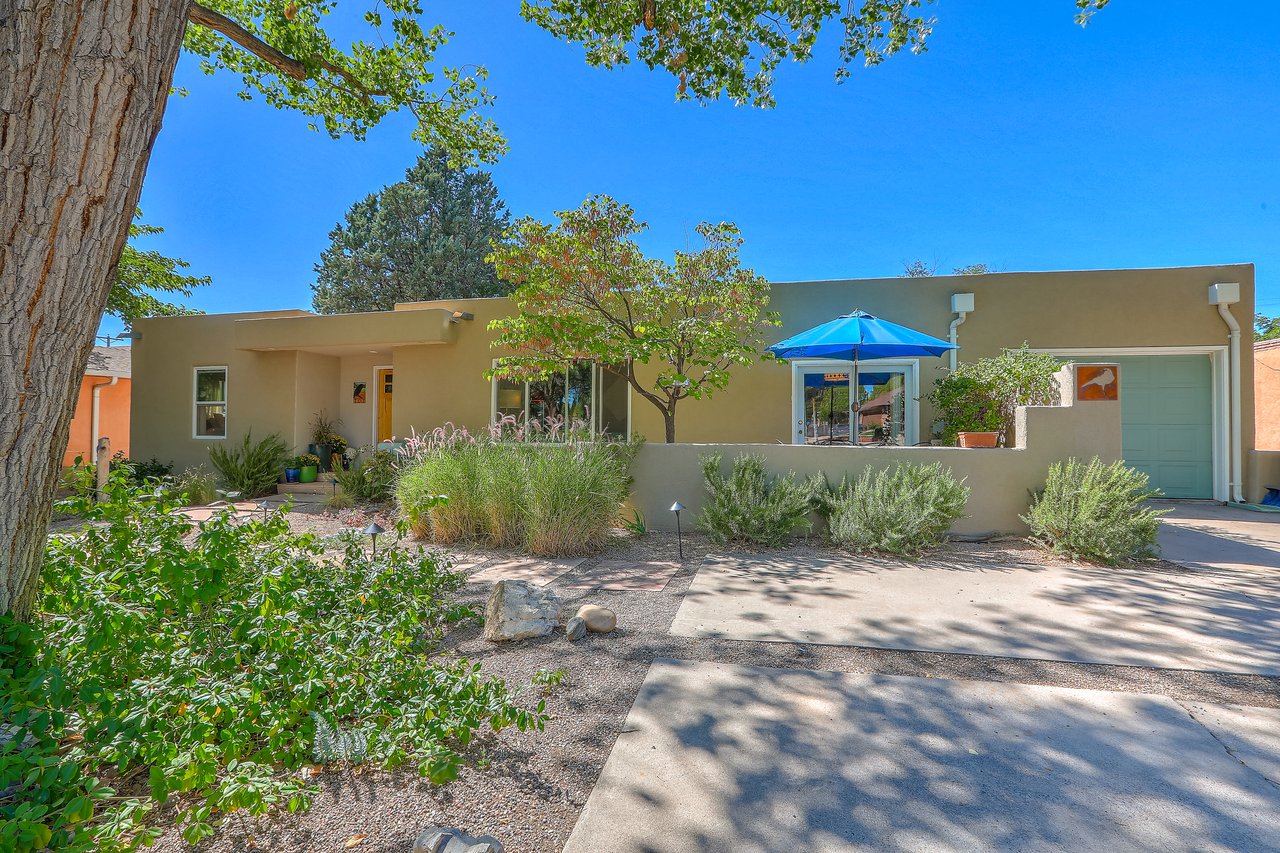
Nob Hill is Albuquerque's most visible mid-century neighborhood precisely because it mixes residential and commercial MCM in a walkable, Central Avenue-facing environment. Located just east of UNM along historic Route 66, the neighborhood's neon signs, preserved storefronts, and residential streets dating from the 1920s through the 1950s create a layered architectural character unlike anywhere else in the city. Homes here range across Art Deco, Spanish Mediterranean, and Mid-Century Modern, with ongoing renovation energy keeping the neighborhood's MCM stock particularly well-maintained.
Adjacent to Nob Hill, the Highland Business District is arguably the densest concentration of commercial mid-century modern architecture in Albuquerque, and it's the subject of the "Hairpin Legs" walking tour run by Modern Albuquerque, the organization dedicated to documenting and celebrating the city's modernist legacy. Along a two-mile stretch, you'll encounter boomerang rooflines, breeze-block screens, and the landmark First National Bank East Tower at San Mateo and Central, standing as a 17-story structure clad in roughly 2.5 million one-inch gold tiles, completed in 1963, that remains the tallest building in Albuquerque outside downtown. It is, by any measure, a monument to the optimism of the era.
Nob Hill offers something increasingly rare in New Mexico: authentic urban mid-century living, walkable to coffee, galleries, and independent restaurants, with the Route 66 history baked into every block.
Neighborhood #7: The Foothills
Later MCM · Dramatic Desert Setting
Albuquerque's Foothills neighborhoods, pressed against the base of the Sandia Mountains in the far Northeast, represent the later edge of the mid-century modern era. Many homes here were built in the 1970s rather than the 1950s or '60s, but the design vocabulary is unmistakably of the same lineage: flat and low-slope rooflines, clerestory windows, open plans, and a pronounced emphasis on connecting interior space to dramatic exterior views. The difference from earlier MCM in the Heights is that Foothills homes sit on larger, more topographically varied lots, and the mountain backdrop is spectacular.
If you want MCM architecture with Sandia views and a degree of privacy unusual for Albuquerque, the Foothills delivers. Proximity to hiking trails, including direct Sandia Mountain access, means the lifestyle complements the architecture, both oriented toward the natural landscape rather than away from it.
The Builders & Architects Who Shaped MCM Albuquerque
Understanding Albuquerque's mid-century modern landscape means knowing the names behind the houses. A handful of builders and architects were responsible for essentially creating the Northeast Heights, and their work defines what "mid-mod Albuquerque" looks like.
Fred Mossman (Mossman-Gladden): 7,500+ homes in the NE Heights across Altamont, Stardust Skies, Highlands North, and Bear Canyon. Signature red-brick construction targeting scientists and military professionals arriving during the Cold War boom.
Dale Bellamah: 13,000+ homes built statewide, including Princess Jeanne Park in the NE Heights (1,600 homes). Bellamah's mission was affordable modernism for working-class families as the "everyman" counterpart to Mossman's more upscale approach.
Max Flatow & Jason Moore: The Flatow & Moore firm defined commercial and civic MCM architecture across Albuquerque, shaping public buildings, banks, and schools that gave the city its modernist institutional character.
George Pearl & W.C. Kruger: Key institutional architects whose banks, schools, and civic buildings helped codify Albuquerque's modernist visual language during its most explosive growth period.
Landmark Mid-Century Modern Buildings to Know
First National Bank East: 5301 Central Ave. NE The defining MCM landmark in Albuquerque. Completed in 1963, it was the tallest building in New Mexico upon opening. Its 17-story tower is clad in approximately 2.5 million one-inch gold mosaic tiles that catch the desert sun in a way that still stops traffic. Nicknamed the "Horizon Pillar" by the contractors who built it.
The Highland Business District (Central Ave. between Carlisle & Wyoming): The most intact stretch of mid-century commercial architecture in the city.
The Alcalde (near Country Club): One of Albuquerque's few mid-century modern high-rise residential buildings, offering vertical mid-century modern living with original tile, concrete floors, and a distinctly Scandinavian-inflected interior palette. With only 29 units in the building, it's a rare opportunity for MCM living in a multi-family format.
Buying a Mid-Century Modern Home in Albuquerque: What to Know
1. Look for the bones, not the finish. Many Albuquerque MCM homes have had kitchens and bathrooms updated... sometimes tastefully, sometimes not. Prioritize structural integrity, original rooflines, floor plans, and windows. Cosmetic reversals are doable; structural changes are expensive.
2. Mossman = quality signal. If a listing identifies a home as a Mossman build, pay attention. The red-brick construction and original oak floors are durable and worth preserving. Don't let vinyl flooring over hardwood discourage you. It's almost always still there underneath.
3. Vista Larga Historic District owners can access state tax credits for improvements that preserve architectural integrity. If you're buying in a documented historic district, consult the New Mexico Historic Preservation Division early.
4. Check the roof. Flat and low-slope roofs are quintessential MCM, but they require different maintenance than pitched roofs. Ensure any flat-roof home has been properly re-roofed within the last 10–15 years.
Frequently Asked Questions: MCM Homes in Albuquerque, NM
What neighborhoods in Albuquerque have the most mid-century modern homes? The Northeast Heights, particularly Altamonte, Stardust Skies, and surrounding Mossman-built neighborhoods, contains the largest concentration of MCM homes in Albuquerque. For more custom, architecturally significant examples, Vista Larga (on the National Register), Netherwood Park, and Altura Park near UNM are the top choices. Four Hills Village in the Southeast is also renowned for its planned MCM community character.
Are Mossman homes in Albuquerque worth buying? Yes. Mossman-Gladden homes are widely regarded as among the best-built production homes from Albuquerque's mid-century boom. Signature red-brick construction, original oak hardwood floors, and quality craftsmanship have made them durable and desirable. They appear throughout Altamonte, Stardust Skies, Altura Park, Hoffmantown, and Princess Jeanne Park neighborhoods.
Is Vista Larga the only historic MCM district in Albuquerque? Vista Larga is the most formally recognized, with its National Register of Historic Places listing and 112 contributing homes. The Sigma Chi Road Residential Historic District also contains documented early modernist examples. The Highland Business District is a de facto historic corridor for commercial MCM architecture, though its formal protections differ.
What are typical mid-century modern home prices in Albuquerque? MCM homes in Albuquerque vary considerably by neighborhood and condition. Production-built ranch homes in the Northeast Heights and Uptown typically list in the $300,000–$450,000 range, while architecturally significant custom homes in Netherwood Park, Vista Larga, or Altura Park can exceed $500,000–$700,000+. Homes listed as mid-century modern have recently shown a median around $370,000, though the most distinctive examples command significant premiums.
Mid-Century Modern Albuquerque — A neighborhood guide for buyers, architecture enthusiasts, and anyone who believes Duke City deserves more credit than it gets.