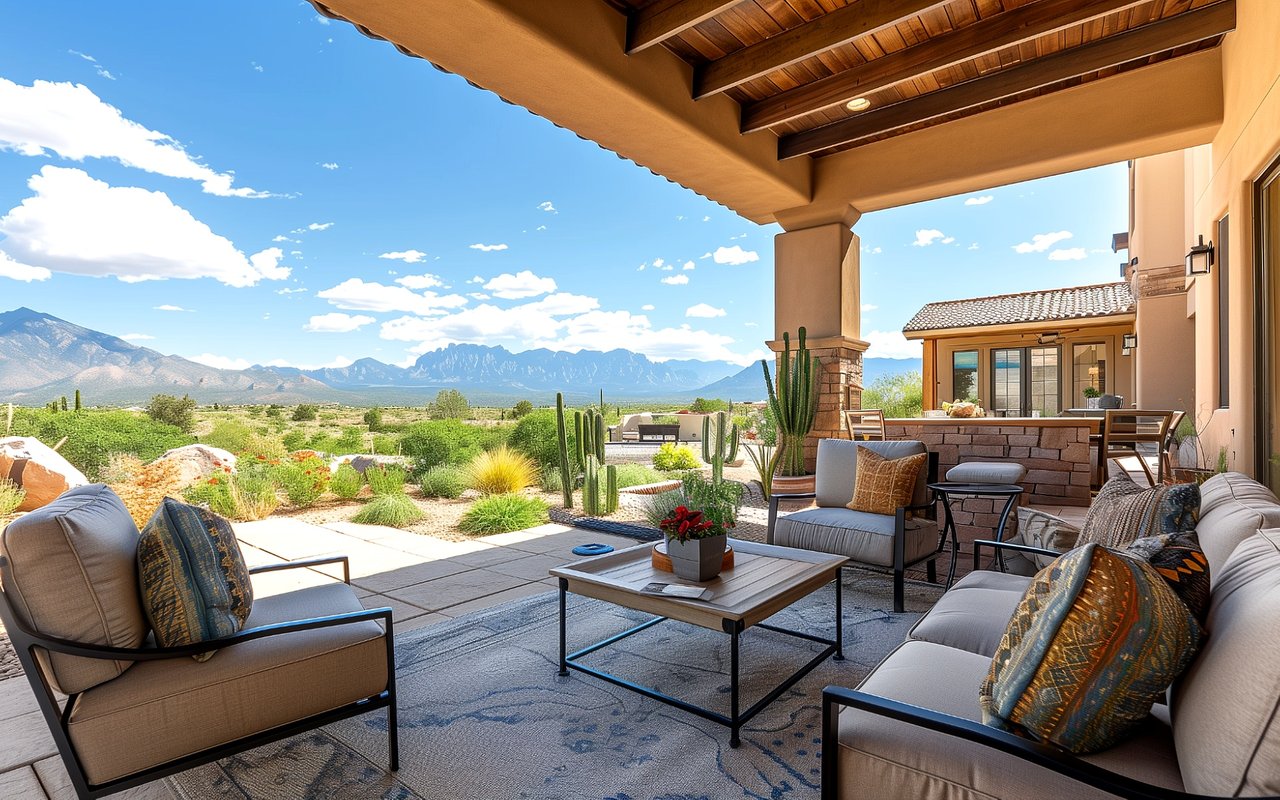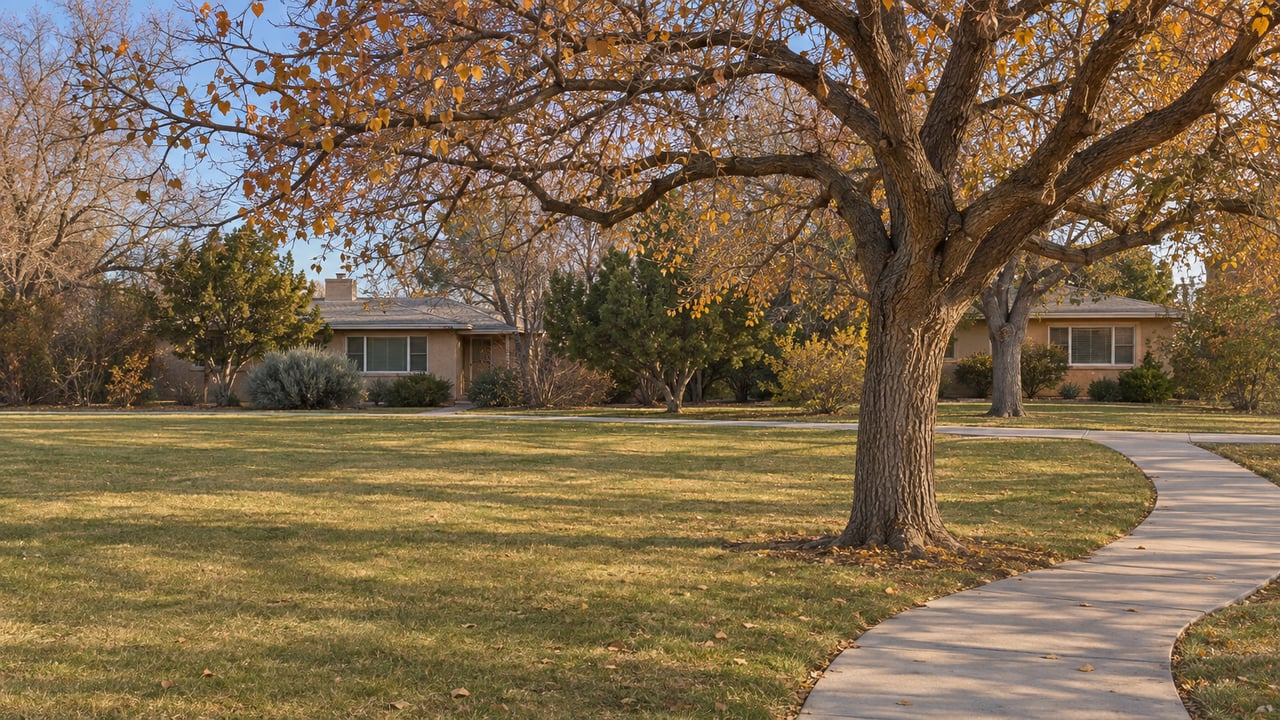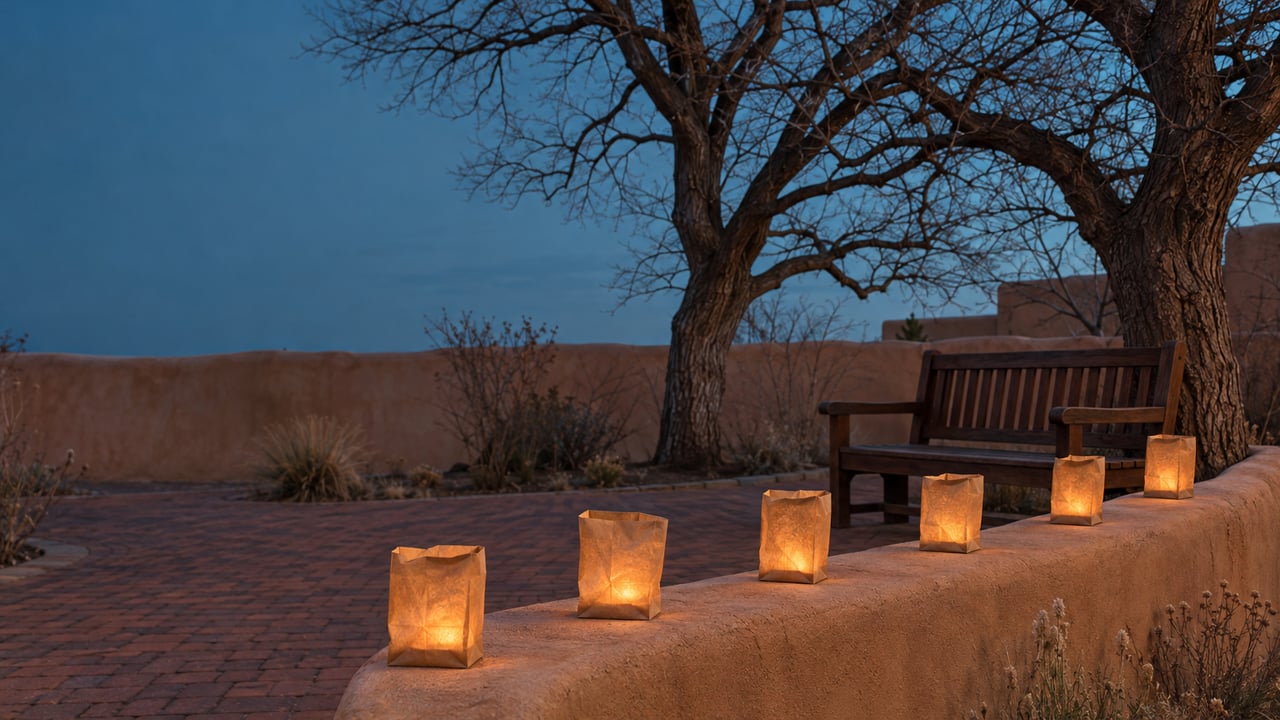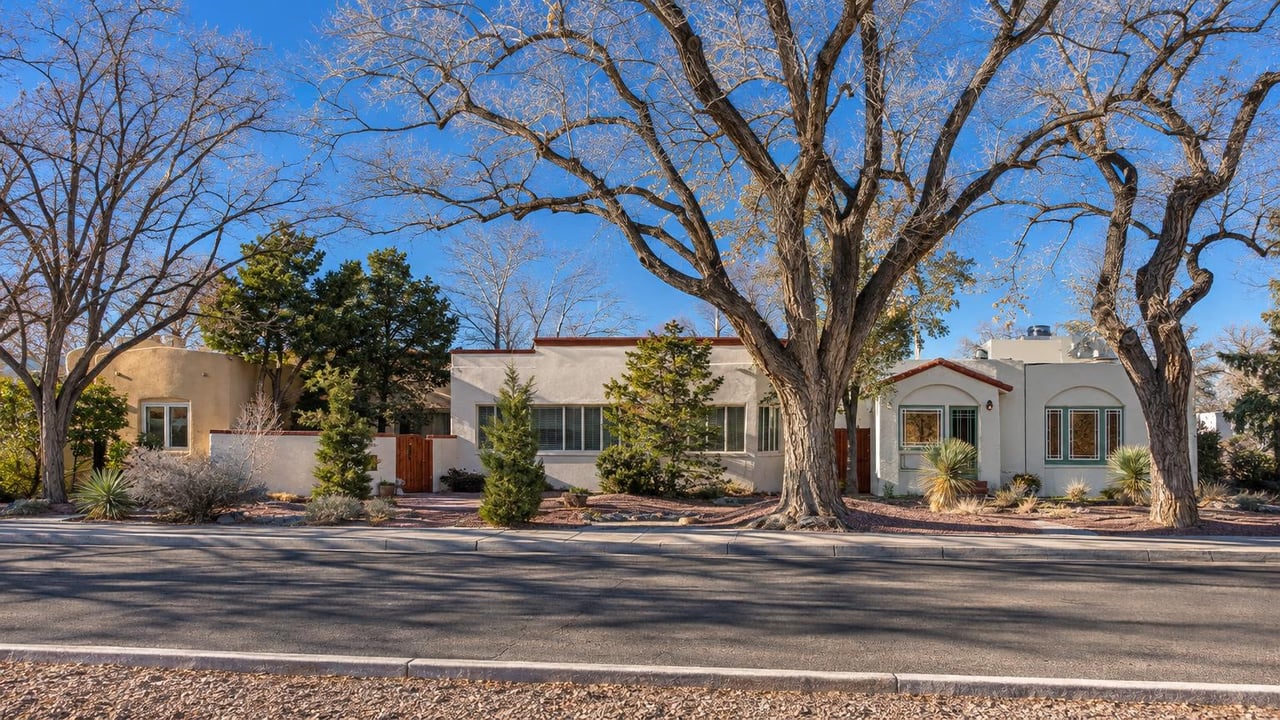
In 1928, the builders Berger and Shaffer opened a red-tile, arched Mediterranean Revival house at 1300 Ridgecrest Drive to the public. It was one of three showcase homes meant to draw buyers out to a dirt mesa that had been annexed to Albuquerque only two years earlier. The house got the name House Practical because a curved drive led back to a two-car garage, which was a new convenience at the time. According to a Nob Hill News account of this spring's Parkland Hills Jane's Walk, Albuquerque Journal ads called the area "Just a whisper from the city and a mile from the sea."
Nearly a century later, House Practical still stands, and it is still the picture most people have of Parkland Hills: stucco, tile roofs, wrought iron and shade trees over a planted median. That picture is accurate for a small share of the neighborhood. Most Parkland Hills homes were built after World War II. The neighborhood also sits on both sides of the line the Greater Albuquerque Association of Realtors uses to split two market areas. If you're comparing it with other neighborhoods, both of those facts affect how you read a listing price.
The Plan Came First, and Only a Few Houses Followed It Before the War
The Parkland Hills Addition was platted in 1926 along Ridgecrest Drive, south of Central and east of Carlisle. A group of local residents had seen the Monte Vista Addition and hired the landscape architect S. R. DeBoer to lay out a subdivision of their own. His plan follows the City Beautiful movement. Lots are oversized and turned forty-five degrees off north, curving streets frame views of the Sandias, and a diagonal axis along Laurel Drive ends at Ridgecrest Park. Parkland Circle makes a ninety-degree bend in the southwest corner, and both Ridgecrest and Carlisle have landscaped medians. The tour guides told Nob Hill News that the addition covered 160 acres when the city annexed it on November 15, 1926, and that Laurel Park was once grazing land for cattle.
Ridgecrest was called Memorial Boulevard until 1931, and it wasn't paved until 1936, when the city extended sewer and water lines to the neighborhood. The medians were planted with grass and trees in the 1930s. In the GAAR history of Albuquerque's early additions, the subdivision "got off to a slow start." Many of its early homes were custom-built by well-known architects and builders, but the northeast section of the plat was laid out as an ordinary north-south grid and wasn't developed until after the war, with "much simpler, smaller homes."
A University of New Mexico architecture thesis on the neighborhood counts how the addition filled in. It found about 50 houses built from 1926 to 1941, a little over 30 during the war years, more than 300 in the postwar boom from 1946 to 1957, and about 50 more as infill from 1958 to 1967. By 1964 the neighborhood was nearly built out.
By that count, roughly one house in nine in the original addition dates from before the war. The Parkland Hills Neighborhood Association area is larger still. Nob Hill News describes it as about 1,500 homes, which makes the prewar houses a much smaller share of what you'll see listed under the Parkland Hills name.
Even Ridgecrest Drive Is Mixed
Ridgecrest Drive is the street in the photographs. Even there, Mediterranean Revival houses are a minority. The UNM thesis counts 82 structures facing Ridgecrest. The 2019 National Register nomination classed 58 of them as contributing to the historic district. Of those 58, 18 are Mediterranean Revival, 14 are Pueblo Revival, 12 are Ranch houses or American Small Homes, 6 are Territorial Revival and 4 are Streamline Moderne. The rest are one Vernacular house, one Contemporary and two Cottage-style houses.
The individual houses that historians name are spread across several decades. The thesis credits A. W. Boehning with the "House Beautiful," or Davis House, at 704 Parkland Circle. Don Shaffer built it, and DeBoer designed its landscape. The Linder House at 915 Ridgecrest is one of the first two houses in Parkland Hills. Next door, 909 Ridgecrest is the 1937 Barrows-Hubbell house, a Pueblo Revival design that Don Cramer designed and built. The Overton House at 1209 Ridgecrest dates to 1948. The thesis names Thomas Benton as the architect-contractor behind several Ridgecrest houses.
The National Park Service record for the Parkland Hills Historic District uses a period of significance of 1926 to 1967. Its listed styles are Mission/Spanish Colonial Revival and Moderne, and it names Kenneth C. Balcomb, Bruce T. Benton and Thomas Benton among the architects. The record ends its period of significance in 1967, which puts the 1950s ranch houses inside the district's history alongside the tile-roofed showcase homes. The district was listed in 2019. Its federal notice gives its boundaries as roughly Zuni Road, Garfield and Smith Avenues, Valverde Drive and Carlisle Boulevard.
The district and the neighborhood association cover different ground. A house can be in Parkland Hills without being in the historic district, and a house in the district can still be a postwar ranch.
The Market Figures Split at San Mateo
GAAR reports sales by MLS area, and its area definitions put a boundary at San Mateo Boulevard. Area 42, UNM South, covers the part east of I-25, south of Central, west of San Mateo and north of Kirtland. Area 71, Southeast Heights, begins east of San Mateo and runs south of Central all the way to Tramway. The historic district's boundaries run east from Carlisle only as far as Valverde, so the prewar core falls on the area 42 side. Nob Hill News describes the association area as reaching east to the South San Pedro neighborhood, which carries part of Parkland Hills over to the area 71 side.
In GAAR's third-quarter 2026 report, published October 16, the medians for those two areas differ by $40,000. From July through September 2026, area 42 had 44 detached sales at a median of $365,000, up 2.96% from the same quarter in 2025. Area 71 had 50 sales at a median of $405,000, up 5.19%. The neighboring areas show a wider spread. Area 40, UNM, north of Central, had a median of $442,750 on 50 sales, and area 70, Fairgrounds, had a median of $294,500 on 26 sales in the same quarter.
Neither the area 42 nor the area 71 median measures Parkland Hills. Each one blends the neighborhood with very different housing. Area 42 extends west to I-25, and area 71 extends east to the foothills at Tramway. A prewar Ridgecrest house on one of DeBoer's angled lots and a 1950s grid house a few blocks away can show up in the same area figure. A Parkland Hills house east of San Mateo is measured against a different set of homes. Comparable sales from the same section and the same building era tell you more than either median.
The market as a whole gives a buyer time to make those comparisons. According to GAAR's October 2026 report, published November 10, the Greater Albuquerque area closed 698 detached sales in October. That was down 11.5% from a year earlier. The median price was $373,500, the median time on market was 25 days, there were 2,375 active listings, and supply stood at 3.3 months. Those are metro-wide figures for October. Still, at about a month on market and more than three months of supply, a buyer has time to check which part of Parkland Hills a house is in and which era it was built in before writing an offer.
What the Neighborhood Shares Across Both Sides
The shared spaces connect the sections of Parkland Hills. Ridgecrest Park is at 820 Ridgecrest SE, Laurel Circle Park is at 902 Ridgecrest SE, and Eunice Kalloch Park is at 1201 Quincy SE. Janet Simon, president of the Parkland Hills Neighborhood Association, told Nob Hill News that the park is named for a neighborhood activist whose husband was a colonel when Kirtland was still an Army base. Kalloch Park is where the association holds its fall festival. Last year's festival had the Highland High School jazz band, a cake walk, piñatas and a costume parade.
The neighborhood's history is also told in person. John Comstock and Bernice Martinez Comstock coordinate Parkland Hills historic tours, and this year's Jane's Walk started at Ridgecrest Park on the first weekend in May. The Parkland Hills Neighborhood Association posts meetings and events, and it links to its own history of the neighborhood. The volunteer nonprofit Parkland Village, which neighbors started in 2017, has historical resources on the neighborhood.
Parkland Hills began with a 1926 landscape plan and was built out by many architects and builders over four decades. For a later Albuquerque plan to compare it with, see our post on Dale Bellamah's Princess Jeanne.
Quick Answers
Which GAAR MLS area is a Parkland Hills house in? GAAR draws the line at San Mateo Boulevard. West of San Mateo is area 42, UNM South. East of San Mateo is area 71, Southeast Heights.
Is every house in the historic district from the 1920s? No. The district's period of significance runs from 1926 to 1967, and the contributing houses on Ridgecrest alone include ranch houses, Streamline Moderne and Territorial Revival alongside Mediterranean Revival.
Where do I start to see the original plan on foot? Start at Ridgecrest Park, 820 Ridgecrest SE, which is where the Laurel Drive axis ends and where this year's Jane's Walk began.
If you're deciding between a 1920s house on DeBoer's diagonal lots and a postwar house on the grid, or between the two sides of San Mateo, talk it through with The Lovely Home Company, and we'll look at recent sales from that section and era of Parkland Hills with you. You can also look at our Southeast Heights neighborhood guide or request a home valuation if you already own on Ridgecrest. Schedule a free consultation, and we'll start with the street you're considering.